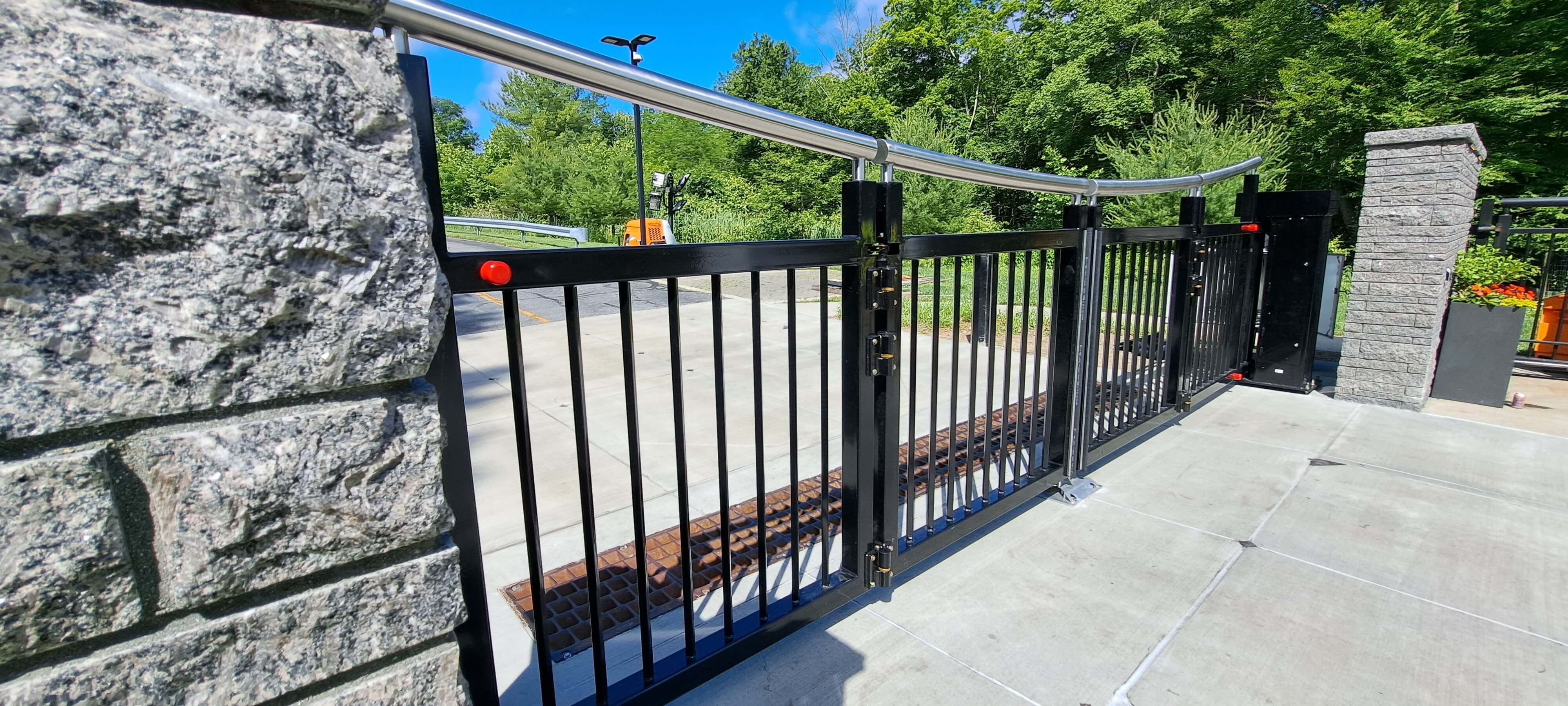
What is vehicle access control
Vehicle access control refers to the structured management of vehicle entry and exit within secured environments. In the context of critical infrastructure in the United States, this involves controlling traffic flows, verifying authorization and aligning vehicle movement with broader security procedures.
Security gates are a key component in this process. They enable controlled throughput of vehicles while supporting integration with access control systems, surveillance platforms and centralized management environments. The objective is not to physically stop high-impact threats, but to create a predictable, controlled and auditable access process.
Designed for US critical infrastructure
Vehicle access control solutions are deployed in environments where operational continuity and controlled access are essential. In the US market, this includes sectors such as logistics, industrial manufacturing, energy infrastructure and data centers.
These environments require a balance between security and efficiency. Vehicle flows must be managed without creating bottlenecks, while ensuring that only authorized vehicles gain access. Security gates support this by structuring entry points, separating traffic flows and enabling verification processes.
Architecture and system integration
Effective vehicle access control is not a standalone solution. It is part of a broader security architecture that connects multiple systems into a unified operational environment.
Security gates can be integrated with:
- - Access control systems for vehicle and driver authorization
- - Video management systems for monitoring and verification
- - Central management platforms for control and reporting
This integration enables real-time decision making, automation of access procedures and full visibility across the site. By connecting vehicle access to identity and security workflows, organizations can improve both security and operational efficiency.
Operational performance in high-traffic environments
In many US applications, vehicle access points must handle continuous and high-volume traffic. This requires systems that deliver consistent performance under demanding conditions.
Security gates are designed to support:
- - Predictable throughput
- - Minimal delays at entry and exit points
- - Continuous operation with limited downtime
By maintaining stable performance, these systems help prevent congestion and ensure that operational processes continue without disruption.
Safety and controlled flow
Safety within vehicle access control focuses on structuring movement rather than blocking force. This includes clearly defined entry and exit lanes, controlled sequencing of vehicles and alignment with site procedures.
Security gates contribute to:
- - Controlled access points
- - Separation of authorized and unauthorized traffic
- - Support of operational safety protocols
This approach ensures that security does not interfere with daily operations, but rather supports a safe and predictable environment.
The role of security gates
Security gates play a central role in enabling vehicle access control. They act as the physical interface between external traffic and secured areas.
Their function includes:
- - Regulating vehicle entry and exit
- - Supporting verification processes
- - Enabling integration with digital systems
It is important to note that these systems are not designed as crash-rated or impact-resistant barriers. Their primary function is control, not physical stopping power.
About
controlled access
Vehicle entry is managed through defined rules, authorization checks and verification processes. This ensures only approved vehicles can access secured zones.
integration driven
The solution connects with existing security systems, creating a unified architecture for managing vehicle access.
operational continuity
Designed for continuous use, the systems support stable operations without disrupting daily processes.
data and insight
Integrated systems provide access to data that can be used to optimize traffic flow and improve security policies.
Highlights
- - Vehicle access control tailored for US critical infrastructure
- - Integration with access control and video management systems
- - Designed for high traffic volumes and continuous operation
- - Supports centralized monitoring and decision-making
- - Not intended as crash-rated or impact-certified barriers
Brochures
All brochures can be found as a download at the product pages of the different speedgates
- B-Trackless, the trackless design eliminates ground rails, enabling reliable operation with minimal maintenance while maintaining fast and controlled perimeter access.
- B-Secure, the system combines fast opening cycles with a reinforced structural design, providing reliable vehicle entrance security for sensitive facilities.
- B-Access, the gate enables efficient vehicle throughput while maintaining reliable perimeter protection for locations with frequent vehicle movements.
- B-protect, the robust design enables fast opening cycles while maintaining reliable perimeter protection for locations where vehicle access must be strictly managed.
Features
- - Controlled vehicle entry and exit
- - Integration with security and management systems
- - Support for operational workflows
- - Scalable across different environments
- - Designed for intensive use
-
FAQ
What is vehicle access control?
It is the process of managing and controlling vehicle entry and exit in secured environments.
Are these security gates crash-rated?
No, these systems are not designed or certified as crash-rated barriers.
Where are these systems used in the USA?
They are used in logistics sites, industrial facilities, energy infrastructure and data centers.
Can these systems integrate with existing platforms?
Yes, integration with access control and video management systems is a key part of the solution.
Are these systems suitable for high-traffic environments?
Yes, they are designed for continuous operation and high vehicle throughput.
What is the main goal of these systems?
The goal is to create controlled, predictable and secure vehicle access processes.